Home / Blog / Groom Weight Loss Plan
Fat loss · India
Groom Weight Loss Plan: How to Get in Shape Before Your Wedding
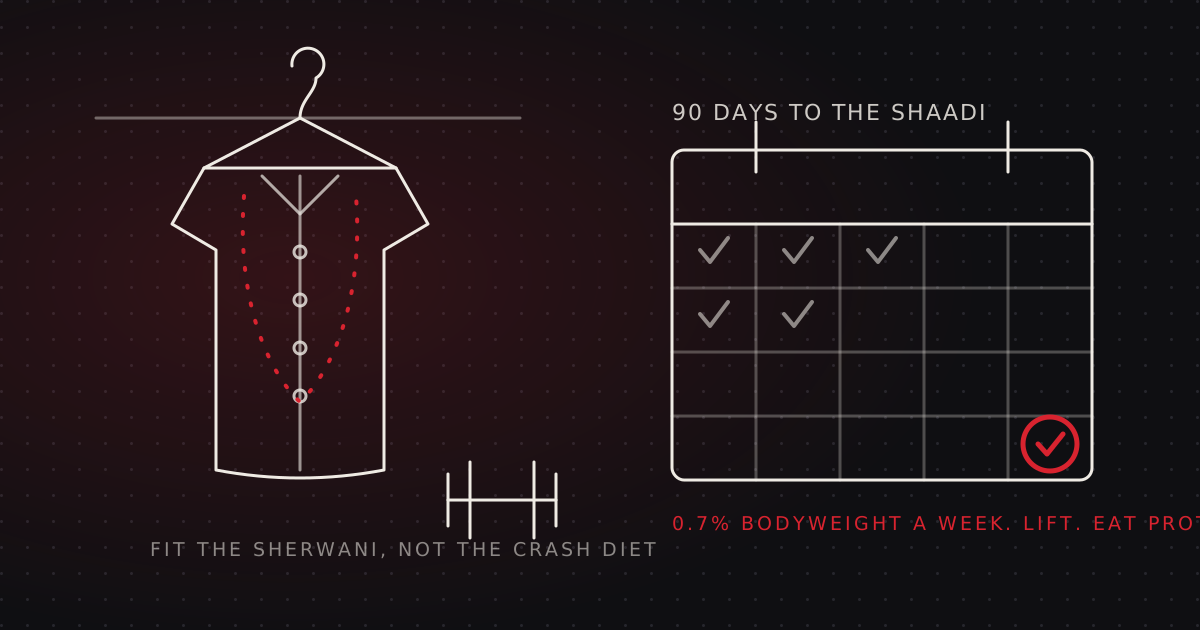
Every bride gets a hundred articles. The groom gets told to hit the gym and figure it out. So here is the version nobody writes for you: what is actually achievable before your date, what to do about eight functions and a fortnight of travel, and how to stop the last two weeks from undoing everything.
You already know your deadline, which is the single biggest advantage you have. Most people fail at fat loss because there is no date. You have one, it is printed on a card, and half of your extended family will be photographing the result. Let us use that properly.
Step 1: do the maths before you do anything else
Grooms consistently pick a target from a photo rather than from arithmetic, then panic at week six. Start with the number that the evidence supports.
Garthe and colleagues, writing in the International Journal of Sport Nutrition and Exercise Metabolism in 2011, randomised elite athletes to lose weight at either 0.7 percent or 1.4 percent of bodyweight per week, with everyone doing four resistance training sessions a week. The slower group gained lean body mass and improved strength while losing fat. The faster group did not fare as well on those measures. The authors recommended aiming for about 0.7 percent per week.
That single number gives you your plan.
| Your weight today | Target loss per week (0.7%) | Realistic loss in 90 days |
|---|---|---|
| 70 kg | About 0.5 kg | Roughly 6 kg |
| 85 kg | About 0.6 kg | Roughly 7 to 8 kg |
| 95 kg | About 0.7 kg | Roughly 8 to 9 kg |
| 110 kg | About 0.8 kg | Roughly 9 to 10 kg |
Two things fall out of this table. First, 90 days is genuinely enough to change how you look in a sherwani and in every photograph taken from now until then. Second, if your goal needs 15 kg in 10 weeks, the goal is wrong, not you. Adjust the target and keep the deadline.
Step 2: build the deficit around Indian food, not around banned lists
You are about to spend three months surrounded by mithai, biryani and family who take refusal personally. A plan that bans foods will not survive that. A plan that manages portions will.
This is not a soft opinion. Johnston and colleagues pooled 48 randomised trials in JAMA in 2014 and found that the branded diets differed very little from each other, concluding that people should follow whichever approach they can adhere to. Adherence is the active ingredient. Choose the version you can run through wedding season.
Practically, for most grooms that means:
- Two solid meals plus one planned lighter meal, rather than constant grazing at the office and at home.
- Protein at every meal without exception. Eggs, chicken, fish, paneer, curd, dal, soya.
- Half the plate as vegetables or salad before the roti and rice go on it.
- Cooking oil measured with a spoon, not poured. This one change is worth several hundred calories a day in most Indian kitchens.
- Liquid calories treated as food. Chai with sugar six times a day, cold drinks, juices and alcohol add up faster than anything on your plate.
If you want the full framework with sample vegetarian and non-vegetarian days, we wrote it out in the Indian diet plan for fat loss.
Step 3: hit your protein target so you lose fat, not muscle
The reason most grooms end up looking smaller but softer is that they lost weight without protecting muscle. Cava, Yeat and Mittendorfer reviewed this in Advances in Nutrition in 2017 and concluded that weight loss should combine adequate protein with resistance type exercise specifically to maintain muscle mass and strength.
For your target, Morton and colleagues analysed 49 studies in the British Journal of Sports Medicine in 2018 and found no further gains in fat free mass beyond roughly 1.6 g of protein per kg of bodyweight per day in training adults. For an 85 kg groom that is around 135 g a day. Anchor to it rather than guessing.
Vegetarian and worried this is impossible? It is not, and we have listed the sources and portions in high-protein vegetarian foods in India.
Your wedding date is fixed. Your plan should not be generic.
Functions, travel, a tailor's deadline and a full-time job do not fit a template. I build the plan around your actual calendar, then check in weekly so the last month does not fall apart.
Message Dion on Instagram →Step 4: lift three or four times a week, and walk every day
Cardio alone will make you lighter. Lifting is what makes the shoulders fill the sherwani. In the Garthe study, the athletes who kept lean mass were doing four resistance sessions a week alongside the deficit. That is your model.
A simple structure that works for a busy groom:
- Three or four sessions a week, 45 to 60 minutes, full body or an upper and lower split.
- Compound lifts first: squat or leg press, a press, a row, a hinge, a pull. Add arms and shoulders at the end if it matters to you, and for wedding photographs it usually does.
- Progress the load or the reps every week. Same weights for 12 weeks means the same body for 12 weeks.
- A daily step target, starting at 8,000 and rising. Steps are how you keep the deficit without cutting food further as the weeks go on.
No gym access during the travel weeks? Do not skip. Run the bodyweight version instead, which we laid out in the full-body home workout with no equipment.
Step 5: survive the functions without derailing
The engagement, the roka, the mehendi, the sangeet, the cousin's wedding two weeks before yours. There will be ten of these. You cannot avoid them and you should not try.
- Eat before you go. A protein-led meal at home means you arrive able to make choices instead of decisions being made for you by hunger.
- Build the plate in order. Salad first, then tandoori or grilled items, dal or a paneer or chicken dish, then a small amount of rice or roti. Anything left is dessert territory.
- Pick sweets or drinks, not both. This one rule handles most of the damage at most functions.
- Alcohol has a second cost. Beyond its own calories, a heavy night usually costs you the next day's food quality, the next day's training and your sleep.
- Return at the very next meal. One heavy dinner is a rounding error. The week you spend writing yourself off afterwards is the actual problem.
Step 6: track weekly, because you will not notice yourself changing
You see yourself every day, which makes you the worst possible judge of your own progress. Track it instead.
This is one of the most consistent findings in the behaviour change literature. Burke, Wang and Sevick reviewed the self-monitoring research in the Journal of the American Dietetic Association in 2011 and found dietary self-monitoring significantly associated with weight loss, with better outcomes among people who logged more consistently. Harkin and colleagues went further in Psychological Bulletin in 2016, meta-analysing 138 studies with nearly 20,000 participants and finding that monitoring progress improved goal attainment, with larger effects when the progress was reported to someone else and physically recorded.
So, every week: weigh yourself on the same day at the same time and use the weekly average rather than any single reading, take a waist measurement at the navel, take the same three photos in the same light, and note whether your lifts moved. Send it to somebody. That last part is not a nice to have, it is the part the research says amplifies the effect.
Step 7: the last three weeks, where most grooms panic
This is the window where people start skipping meals, doubling cardio and buying whatever the shop assistant recommends. Do the opposite.
- Hold the plan, do not tighten it. Cutting harder now costs you muscle and energy at the exact moment you need both.
- Protect sleep like it is part of the plan. Poor sleep in the final fortnight will do more visible damage than one extra dessert.
- Do not attempt dehydration or water cutting tricks. Those belong to stage athletes for a few hours, not to a groom facing three days of ceremonies, heat and travel.
- Keep training right up to the week of the wedding, just reduce the volume. You will look fuller, not flatter.
- Book the final sherwani fitting about two weeks out, once the majority of the loss is done. Take earlier measurements for your own record, but never let the tailor's calendar push you into an unsafe rate of loss.
What to do this week
- Count the weeks to your date. Multiply your weight by 0.007 to get your weekly target.
- Write down every function between now and the wedding. That is your real calendar, not a blank 12 weeks.
- Set a protein target of about 1.6 g per kg and build three default meals you can repeat without thinking.
- Book three gym sessions into your week as fixed appointments, the same way you would book a vendor meeting.
- Take your starting photos and measurements today, before anything changes.
Do not spend the next 90 days guessing
I coach a limited number of people personally, with weekly check-ins and a plan that adjusts when the functions and travel start. If your wedding is coming, message me with the date and your current situation and I will tell you straight what is achievable.
Message Dion on Instagram →See real client transformations first, or follow @dionsamuel_ on Instagram.
Frequently asked questions
How much weight can I realistically lose in 90 days before my wedding?
At about 0.7 percent of bodyweight per week, an 85 kg groom loses roughly 0.6 kg a week, which is around 7 to 8 kg in 90 days while keeping muscle and strength. Heavier grooms can expect more, lighter grooms less.
Is 30 days enough?
Thirty days will not transform you, but it will visibly change your waist, your face and how your clothes fit. Use the same rate, do not crash, and start immediately rather than spending a week choosing a plan.
Should I do more cardio to speed things up?
Add steps before you add cardio sessions, and never remove lifting to make room for it. Resistance training is what keeps the weight you lose from coming out of your shoulders and arms.
How do I handle the sangeet and reception dinners?
Eat a protein-led meal before you go, build the plate salad first and protein second, choose either sweets or drinks, and return to the plan at the very next meal.
When should I get my sherwani fitted?
Final fitting around two weeks before the wedding, once most of the fat loss is done. Earlier measurements are useful as progress markers, but the tailoring date should never dictate an unsafe rate of loss.
What about fat loss injections and quick fixes?
Anything pharmaceutical is a medical decision that belongs with your doctor, not with a coach or a wedding countdown. Everything in this article is the part you control regardless.
Sources
- Garthe I, Raastad T, Refsnes PE, Koivisto A, Sundgot-Borgen J. Effect of two different weight-loss rates on body composition and strength and power-related performance in elite athletes. International Journal of Sport Nutrition and Exercise Metabolism, 2011. PubMed
- Morton RW et al. A systematic review, meta-analysis and meta-regression of the effect of protein supplementation on resistance training-induced gains in muscle mass and strength. British Journal of Sports Medicine, 2018. PubMed
- Cava E, Yeat NC, Mittendorfer B. Preserving healthy muscle during weight loss. Advances in Nutrition, 2017. Full text
- Johnston BC et al. Comparison of weight loss among named diet programs in overweight and obese adults: a meta-analysis. JAMA, 2014. PubMed
- Burke LE, Wang J, Sevick MA. Self-monitoring in weight loss: a systematic review of the literature. Journal of the American Dietetic Association, 2011. Abstract
- Harkin B et al. Does monitoring goal progress promote goal attainment? A meta-analysis of the experimental evidence. Psychological Bulletin, 2016. Full text