Home / Blog / Choosing an Online Coach
Coaching · India
How to Choose an Online Fitness Coach in India
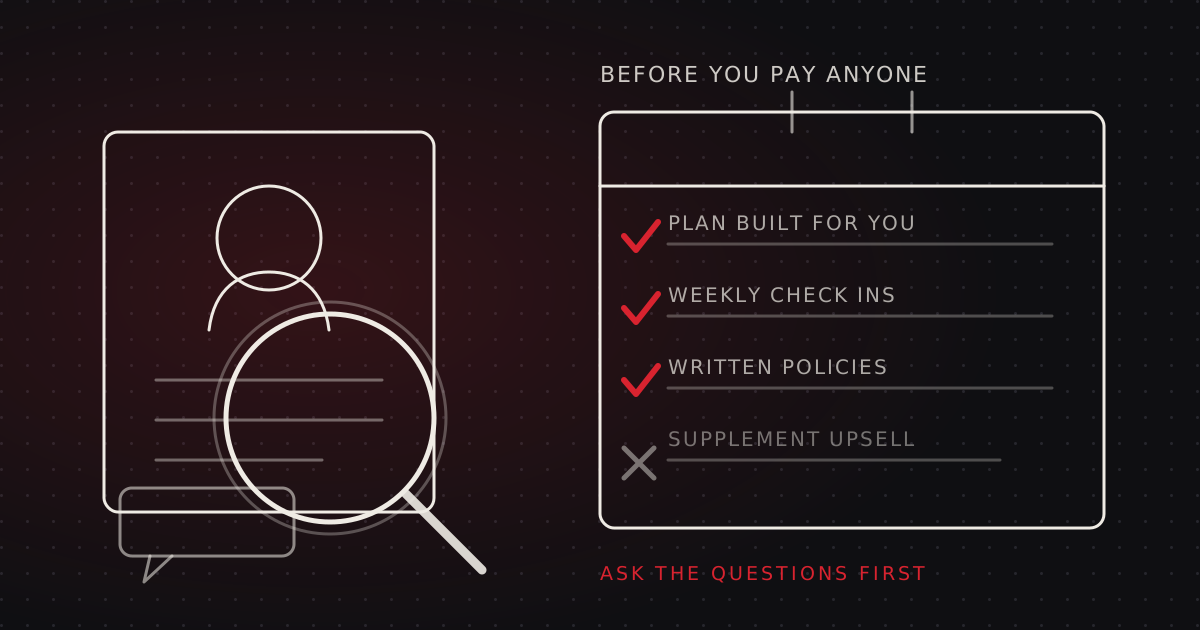
Everybody with a phone and a physique is selling coaching now. Some of them are excellent. Many are selling the same PDF to four hundred people. This is the checklist I would use if I were the one paying, written by someone who sits on the other side of that conversation every week.
Here is the honest context. The ICMR-INDIAB national survey, published in The Lancet Diabetes & Endocrinology in 2023, found generalised obesity in 28.6 percent and abdominal obesity in 39.5 percent of Indian adults surveyed across 31 states. That is an enormous market, and enormous markets attract people who are good at selling and average at coaching. Your job is to tell them apart in one conversation.
First, be clear about what you are actually buying
People think they are buying a diet chart and a workout plan. They are not. Those are the cheapest part of the service and always have been. What you are buying is the thing that makes you follow the plan on week nine, when the novelty has gone and work is on fire.
The research backs this up uncomfortably well. Johnston and colleagues pooled 48 randomised trials covering roughly 7,300 adults in JAMA in 2014 and found that the branded diets barely differed from each other in weight loss. Their conclusion was that clinicians should recommend whichever diet a patient will actually stick to. Translated for you: the plan being "the best plan" matters much less than whether you can run it for six months. So evaluate a coach on adherence support, not on how clever their macro split sounds.
What the evidence says makes coaching work
Three findings are worth knowing before you compare offers, because they tell you which features are load bearing and which are decoration.
- Monitoring your progress changes the outcome. Harkin and colleagues meta-analysed 138 studies with almost 20,000 participants in Psychological Bulletin in 2016 and found that prompting people to monitor progress towards a goal significantly improved goal attainment. Crucially, the effect was larger when progress was reported to someone else and when it was physically recorded. That is the entire argument for a weekly check-in with a human being.
- Consistent logging predicts results. Burke, Wang and Sevick reviewed the self-monitoring literature in the Journal of the American Dietetic Association in 2011 and found dietary self-monitoring was significantly associated with weight loss, with better results in people who submitted their records more consistently.
- A human coach beats an app alone. Systematic reviews of digital weight management published in JMIR journals report that apps paired with coaching or human feedback produce meaningfully greater weight loss than control conditions, with pooled differences of roughly 2 kg over three to six months. Not magic. But that is the gap between an app you abandon in February and a process you finish.
Notice what is missing from that list. Nobody found that the winner was a fancier app, a rarer exercise, or a diet with a name. Contact, tracking and accountability did the work.
Want to see what a real check-in looks like?
I will happily walk you through how my weekly check-ins run, what data I ask for and how the plan changes because of it, before you commit to anything. No payment at the enquiry stage.
Ask me on Instagram →The 12-point checklist
Run any coach through these. You are looking for plain, specific answers, not adjectives.
The plan itself
- Who writes my plan, and is it built after you know my situation? A plan written before anyone asks about your job, your kitchen, your injuries and your gym equipment is not a plan, it is a template.
- Is it built around food I already eat? If a coach in India cannot build fat loss around dal, roti, rice, curd and sabzi, they are going to hand you something you quit in three weeks. We covered exactly this in our Indian diet plan for fat loss.
- What happens when I have no gym access for two weeks? Travel, shifting house, wedding season, hostel. The answer should be immediate and specific, not "we will see".
- What is my protein target and where does the number come from? A competent coach can tell you their target and their reasoning. The commonly used ceiling for training adults comes from Morton and colleagues in the British Journal of Sports Medicine in 2018, whose analysis of 49 studies found no further gains in fat free mass beyond roughly 1.6 g per kg of bodyweight per day.
The contact
- How often do we check in, and in what format? Weekly is the standard worth paying for. Given the Harkin findings, this is the part you are really buying.
- Who replies to my messages, you or an assistant? Both can be fine. Being told one and getting the other is not.
- What is your realistic reply time? Twenty four hours is a fair answer. Silence for a week is not.
- How many clients are you handling right now? Watch the reaction more than the number. Coaches who cap their roster tend to say so proudly.
The business side
- Can I pause if I get injured, sick or hit exam season? Life will interrupt. Ask before it does. Our own refund and cancellation policy is written down publicly for exactly this reason.
- Are supplements compulsory? They should never be. If your coach earns a cut on the stack they prescribe, you have a conflict of interest sitting inside your nutrition plan.
- Where are your terms, privacy and refund policies? If a coaching business cannot show you these on a website, you have no idea what you are agreeing to.
- Can I speak to or see the results of clients like me? Not the one genetic outlier. Someone with your job, your starting point and your constraints. Ours are on the results page.
Red flags that predict a bad experience
- Guaranteed kilos in a guaranteed time. Nobody can promise a biological outcome. Anyone who does is either inexperienced or comfortable lying to you.
- A crash protocol. Very low calorie plans with no resistance training cost you muscle along with fat. Cava, Yeat and Mittendorfer laid this out in Advances in Nutrition in 2017, concluding that weight loss should pair adequate protein with resistance type exercise specifically to protect muscle.
- One PDF for everyone. Ask what would be different in your plan compared to the last client. If nothing is, you are buying a document.
- Payment pressure before any conversation. Urgency, expiring discounts and "only two slots left" every single week.
- Untraceable transformation photos. Different lighting, different bathroom, no timeline, no name.
- No written policies anywhere. Covered above, and worth repeating, because it is where most disputes end up.
- Contempt for your questions. The way a coach handles being questioned before payment is exactly how they will handle a bad week in month three.
Green flags most people miss
Some of the best signals are quiet ones. A coach who tells you that you do not need coaching yet. A coach who asks about your sleep and your work timings before your goal weight. A coach who has content about the boring foundations rather than only shredded photos. A coach who says "I do not know, let me check" about something medical, and points you to a doctor.
And one more that people underrate: does the coach work with people who look like your life? If you do night shifts, someone who has actually solved that problem before is worth more than a bigger following. That is why we wrote the guide on losing weight on night shifts instead of pretending the problem does not exist.
How to make the decision in one week
- Shortlist three coaches, no more. More options means more delay and no more clarity.
- Send all three the same five questions on the same day.
- Score the replies on specificity, honesty and speed. Ignore follower counts entirely.
- Have one actual conversation with the top scorer. You are testing whether you can be honest with this person on a bad week.
- Read their written policies before paying. All of them, once.
- Start. The best plan you begin in August beats the perfect plan you begin in January.
Start with a conversation, not a payment
I coach a limited number of people at a time, personally. Message me on Instagram with your goal, your schedule and whatever is currently getting in the way. If coaching is not right for you, I will tell you that instead of selling you something.
Message Dion on Instagram →Frequently asked questions
Is online coaching actually effective, or is a free app enough?
Reviews of digital weight management studies find that pairing self-monitoring tools with a human coach produces more weight loss than control conditions, with pooled differences of roughly 2 kg over three to six months. The app collects the data. The coach is the reason you act on it in week nine.
What should I ask before paying an online coach?
Who writes the plan, how often you check in, who replies to your messages, what changes when life changes, whether supplements are compulsory, what happens if you need to pause, and where the written policies live.
What are the biggest red flags?
Guaranteed kilos in a fixed time, compulsory supplement stacks sold by the same person, one PDF for everyone, no written refund or pause policy, payment pressure before any real conversation, and transformation photos that cannot be traced to a real client.
Does my coach need to be in my city?
No. Responsiveness and understanding of your food, schedule and equipment matter far more than geography. What does matter is that the coach understands Indian kitchens and Indian work timings.
How long before I should expect to see something?
Give any sensible plan four to six weeks of honest adherence before judging it. Judge the coaching sooner than that: within two weeks you will know whether the check-ins are real and whether the plan is adapting to you.
Sources
- Anjana RM et al. Metabolic non-communicable disease health report of India: the ICMR-INDIAB national cross-sectional study. The Lancet Diabetes & Endocrinology, 2023. Read the study
- Johnston BC et al. Comparison of weight loss among named diet programs in overweight and obese adults: a meta-analysis. JAMA, 2014. PubMed
- Harkin B et al. Does monitoring goal progress promote goal attainment? A meta-analysis of the experimental evidence. Psychological Bulletin, 2016. Full text
- Burke LE, Wang J, Sevick MA. Self-monitoring in weight loss: a systematic review of the literature. Journal of the American Dietetic Association, 2011. Abstract
- Chew HSJ et al. Effectiveness of combined health coaching and self-monitoring apps on weight-related outcomes. Journal of Medical Internet Research, 2023. Full text
- Morton RW et al. A systematic review, meta-analysis and meta-regression of the effect of protein supplementation on resistance training-induced gains in muscle mass and strength. British Journal of Sports Medicine, 2018. PubMed
- Cava E, Yeat NC, Mittendorfer B. Preserving healthy muscle during weight loss. Advances in Nutrition, 2017. Full text